

The Benefits of Payroll Integration and Time Tracking
Summarise the blog with AI

Time tracking and payroll integration for benefits platforms sounds straightforward until you’re supporting 15 different payroll systems, each with different deduction formats, pay period structures, and write-back requirements. This guide covers what benefits payroll integration actually requires when time tracking data needs to flow to payroll reliably.
Key Highlights:
- Benefits deduction writeback to payroll is one of the most technically complex integration workflows in HR Tech — it requires write access that most payroll vendors restrict to formal partners.
- Time tracking integration introduces a third layer of complexity: connecting attendance data, leave balances, and hours worked to both the benefits platform and the payroll system.
- The biggest failure mode is building read-only integrations and discovering write-back requirements late in the enterprise sales cycle.
- Bindbee provides pre-negotiated write access across 65+ payroll and HRIS systems, including the deduction and contribution write endpoints that benefits platforms need.
The Three-Way Data Problem

Benefits payroll integration with time tracking involves three data systems that need to stay synchronized:
- Time tracking system: Clock-in/out data, leave requests, PTO balances, overtime calculations
- Benefits platform: Enrollment elections, dependent coverage, premium calculations, deduction amounts
- Payroll system: Employee records, pay groups, deduction configurations, payroll runs
The challenge is that changes in any one system need to propagate correctly to the others. A PTO approval in the time tracking system should update the payroll run. A benefits enrollment change should update the deduction in payroll. An employee termination in the HRIS should trigger benefits offboarding in the benefits platform.
The Write-Back Problem
Most HRIS and payroll integrations start with read access: pulling employee data to populate the benefits platform. Write-back — pushing deduction changes, enrollment updates, and contribution rates back to payroll — is a different challenge entirely.
Payroll write access requires:
- Formal partner program approval from the payroll vendor
- Specific API endpoints for deduction configurations, not just employee data
- Write permission scopes beyond standard read-only OAuth flows
- Testing against payroll sandbox environments before production deployment
The approval process for write access can take months. Companies that discover this requirement during an enterprise sales cycle often lose the deal while waiting for partner approval.
Time Tracking Specific Requirements
Time tracking data introduces additional complexity for benefits platforms:
- Leave balances: PTO and sick leave balances affect benefits eligibility calculations and should sync bidirectionally
- Hours worked: For benefits that are hours-dependent (some healthcare plans, contractor benefits), hours data from time tracking directly feeds benefits eligibility
- Overtime: Overtime hours affect compensation calculations that flow into benefits premium calculations for income-based plans
- Termination handling: Clock-out timestamps and last working day data are critical for COBRA trigger timing
How Bindbee Handles Benefits Payroll Integration with Time Tracking
Bindbee’s unified API covers the full data flow for benefits payroll integration:
- Timesheets model: Standardized access to time tracking data including hours worked, overtime, and shift data across connected HRIS and time tracking systems
- Time Off model: Leave requests, approvals, and balance data synced from the HRIS to your benefits platform
- Deduction write-back: Pre-negotiated write access to push benefits deductions directly to payroll across 65+ systems
- Pay Groups: Access to pay group configurations that determine deduction timing and frequency per employee
- Webhooks: Real-time events for employment changes, terminations, and leave approvals — no polling delays
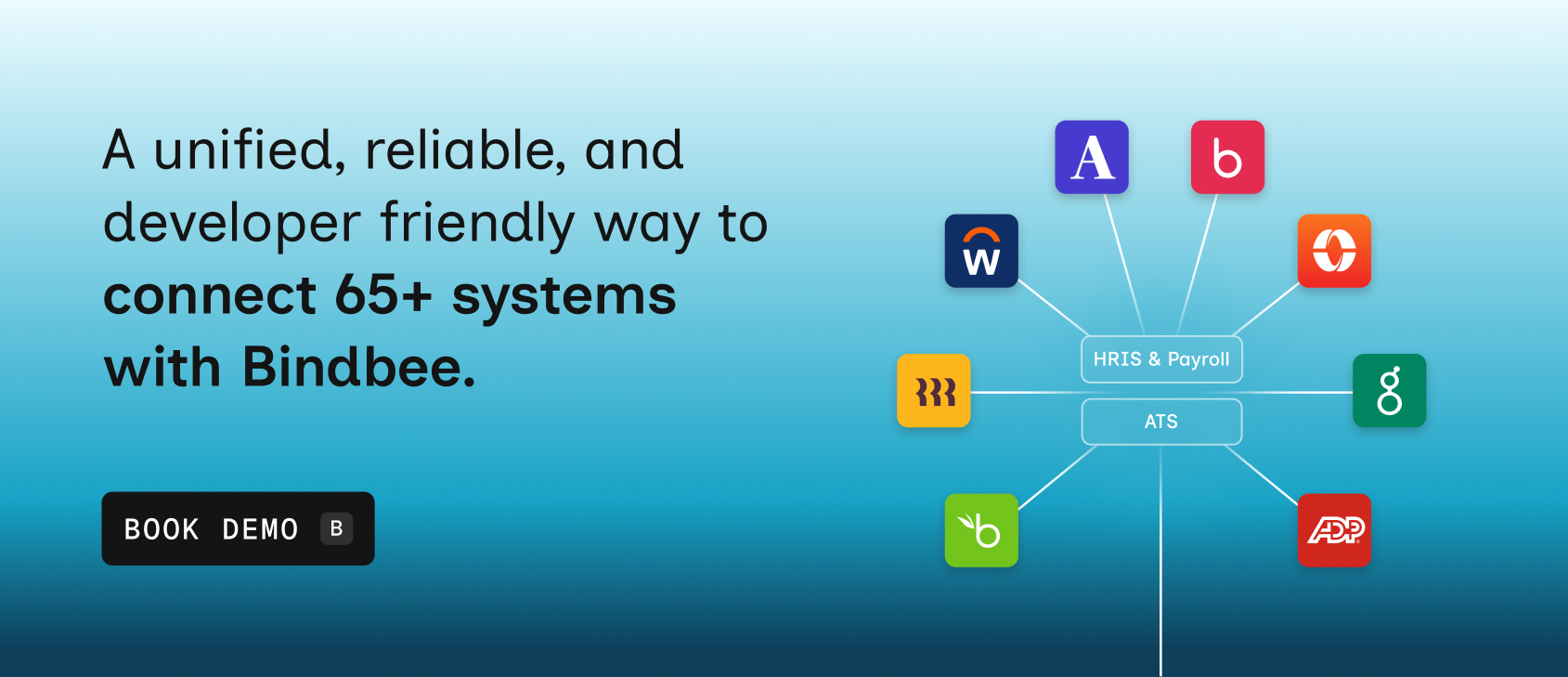
Book a demo to see how Bindbee handles benefits payroll integration with time tracking data across 65+ systems.