

Breaking Silos: Evolution of Unified API Integration
Summarise the blog with AI

API integration has evolved significantly from simple point-to-point connections to sophisticated unified platforms. Understanding this evolution helps HR Tech and benefits companies make better architectural decisions today.
The Three Eras of Integration
Era 1: Point-to-Point (1990s–2000s)
Early software integration meant connecting two systems directly. One integration, one connection. This worked when businesses had three or four key systems. It became a maintenance nightmare as companies scaled.
Each point-to-point connection required:
- Custom authentication per system
- Proprietary data formats and mappings
- Individual monitoring and error handling
- Separate maintenance as APIs changed
Era 2: iPaaS and Middleware (2000s–2010s)
Integration platforms like MuleSoft and Dell Boomi emerged to centralize and standardize connections. They introduced reusable connectors and workflow automation, reducing some of the duplication. But they still required significant configuration for each new system and relied on generic data models that often lacked the depth needed for specific verticals.
Era 3: Unified APIs (2010s–Present)
Unified APIs take a different approach. Instead of connecting everything to everything, they focus on a specific category of systems and normalize the data model across all of them.
For HR Tech, this means one API that:
- Covers all major HRIS, payroll, and ATS platforms
- Returns consistent data structures regardless of source system
- Handles authentication, pagination, and field mapping internally
- Maintains connections as vendor APIs change
Why Unified APIs Matter for HR Tech
The shift from iPaaS to unified APIs wasn’t just architectural. It reflected a change in how software companies thought about integration:
- Old model: Integration as a project. Build each connection when a customer needs it.
- New model: Integration as infrastructure. Deploy once, cover the entire category.
This matters for benefits platforms and HR Tech companies because their customers are distributed across dozens of HRIS and payroll platforms. The unified API model turns that fragmentation into a solved problem.
Bindbee and the Current State of Unified Integration
Bindbee is built on the unified API model for HR specifically. Connecting once gives your product normalized access to Workday, ADP, UKG, Rippling, BambooHR, Gusto, Paychex, and 65+ other HRIS and payroll systems through a single, consistent API. The data models cover employees, payroll runs, compensation, benefits, dependents, time-off, and more, with the depth that HR Tech products actually need.
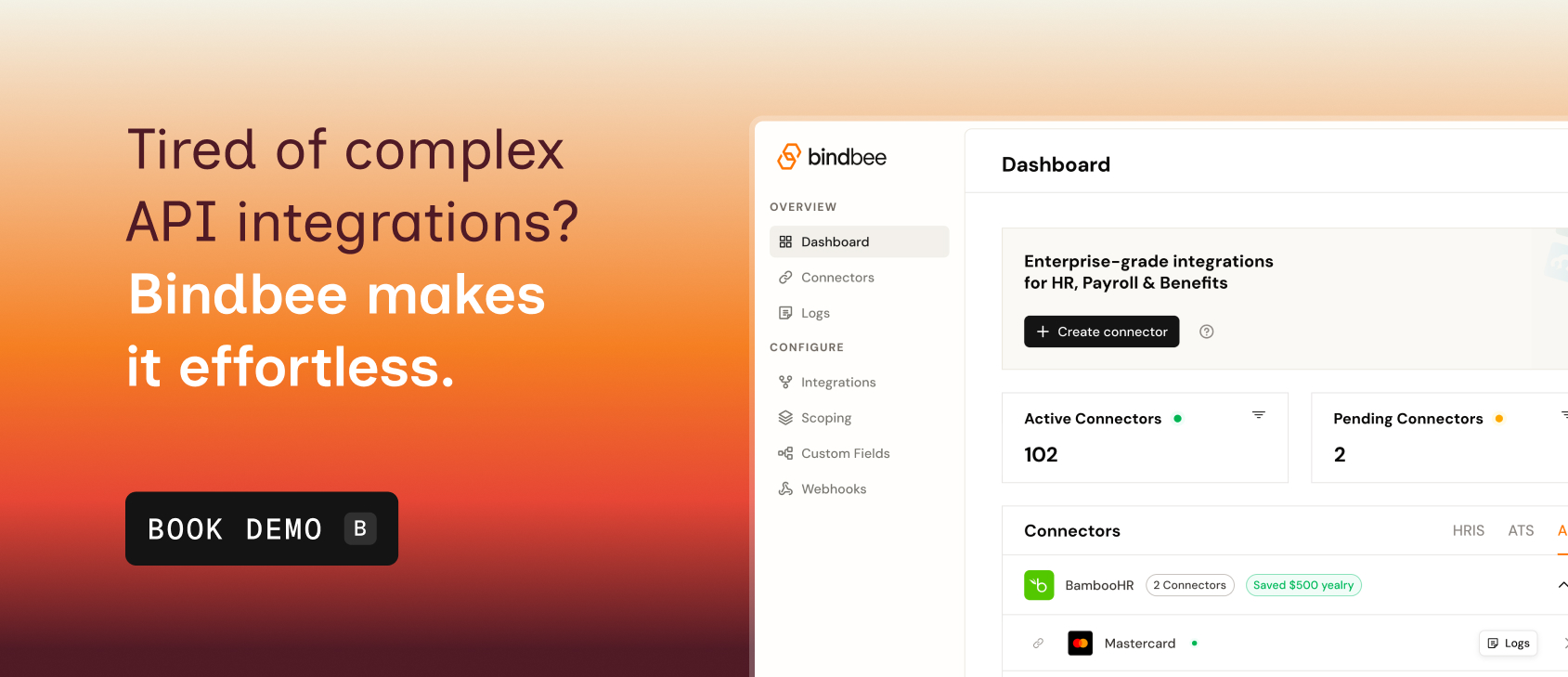
Book a demo to see how Bindbee represents the current state of unified integration for HR Tech.