

What Is an Integration Partner? Explained
Summarise the blog with AI
.avif)
Ever wondered why some companies scale their integrations in weeks while others spend months rebuilding the same connectors?
The answer almost always comes down to architecture. Companies that scale fast treat HRIS integration as infrastructure, not as individual projects.
What Integration Partners Mean in HR Tech
An integration partner in HR Tech context means a company whose HRIS, payroll, or ATS platform you need to support. Your customers are on these platforms. If you can’t connect to them, you lose deals or rely on manual workarounds that don’t scale.
The conventional approach is to build integrations one by one as customers demand them. The problem: each integration takes 4–8 weeks, requires ongoing maintenance, and the list never stops growing.
The Build vs. Partner Decision
Every new HRIS integration is a build vs. partner decision:
- Build direct: Full control, but 4–8 weeks per integration, ongoing maintenance as vendor APIs change, and engineering bandwidth permanently allocated to integrations instead of product.
- Partner through a unified API: One integration to Bindbee covers Workday, ADP, UKG, Rippling, and 65+ other systems. Maintenance shifts to Bindbee. New systems go live without additional engineering.
Why the Model You Choose Determines Your Ceiling
At 5 integrations, building direct is manageable. At 15–20, you’re running a maintenance operation that competes with product work for engineering time. The companies that scale integration coverage fastest made the decision early that HRIS connectivity is infrastructure, not differentiation.
The integration partners that win are the ones that make it easy for other platforms to connect to them. The HR Tech companies that win are the ones that make it easy to connect to all of their customers’ systems.
What This Looks Like in Practice
Benefits platforms and HR Tech companies using Bindbee’s unified API get:
- Coverage across 65+ HRIS, payroll, and ATS systems from a single integration
- Deep data models that cover the benefits-specific fields other tools miss
- Write-back support for deductions, contributions, and enrollment updates
- Ongoing maintenance as vendor APIs change, without touching your codebase
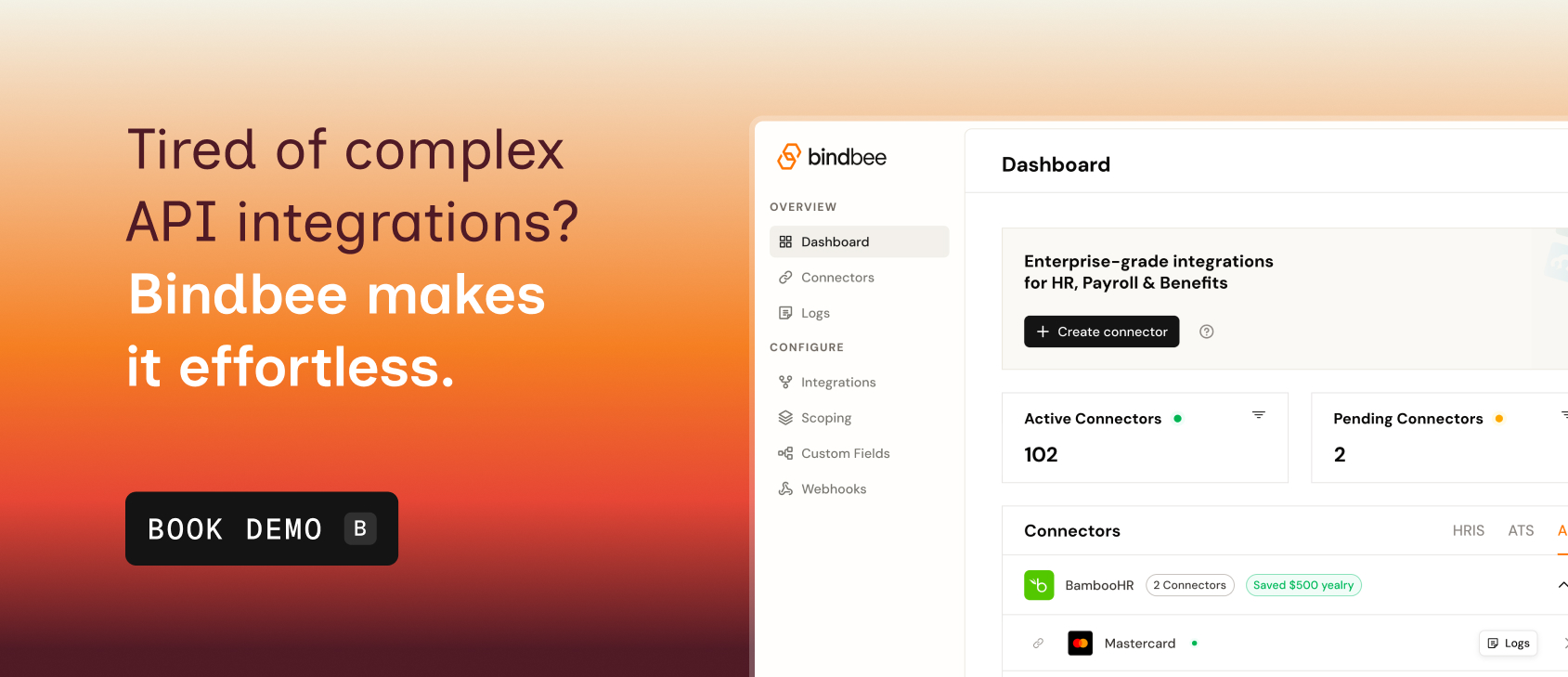
Book a demo to see how Bindbee fits into your integration partner strategy.