

Paragon vs Unified: Choosing the Right Integration Platform
Summarise the blog with AI
Did you know that only 40% of companies have a formal strategy for managing their API ecosystem? That gap is where integration complexity compounds — every new system added without a strategy creates technical debt, slows onboarding, and ties up engineering.
This guide compares Paragon and Unified.to, two embedded integration platforms, and explains how Bindbee fits for HR Tech and benefits companies with specific HRIS integration needs.
What Paragon Is
Paragon is an embedded iPaaS. It lets you add pre-built integrations to your SaaS product through a white-labeled UI that your customers interact with directly. It covers a broad range of application categories: CRM, project management, marketing, analytics, and more.
Paragon is well-suited for:
- Products that need to connect many different types of applications (not just HR)
- Teams that want a no-code UI for customers to manage their own integrations
- General-purpose workflow automation across heterogeneous stacks
The limitation for HR Tech is breadth over depth. Paragon’s HRIS connectors expose basic employee fields but don’t cover benefits-specific data like dependents, deductions, payroll runs, and enrollment details that HR Tech platforms need.
What Unified.to Is
Unified.to is a horizontal unified API. It normalizes data across multiple integration categories: HRIS, ATS, CRM, marketing automation, and others. The approach is similar to Bindbee but applied across many verticals instead of going deep in one.
Unified.to is well-suited for:
- Products that need thin coverage across many integration categories
- Teams that want to avoid building connectors for CRM and HRIS simultaneously
- Use cases where breadth of coverage matters more than depth in any single category
Where Bindbee Fits
Bindbee is a vertical unified API built specifically for HR. It doesn’t try to cover CRM or marketing — it goes deep in HRIS, payroll, ATS, and benefits data specifically.
The data models cover employees, payroll runs, compensation history, dependents, benefits enrollment, deductions, time-off, pay groups, and org structure. That depth exists because HR Tech products need it, and generalist platforms don’t prioritize it.
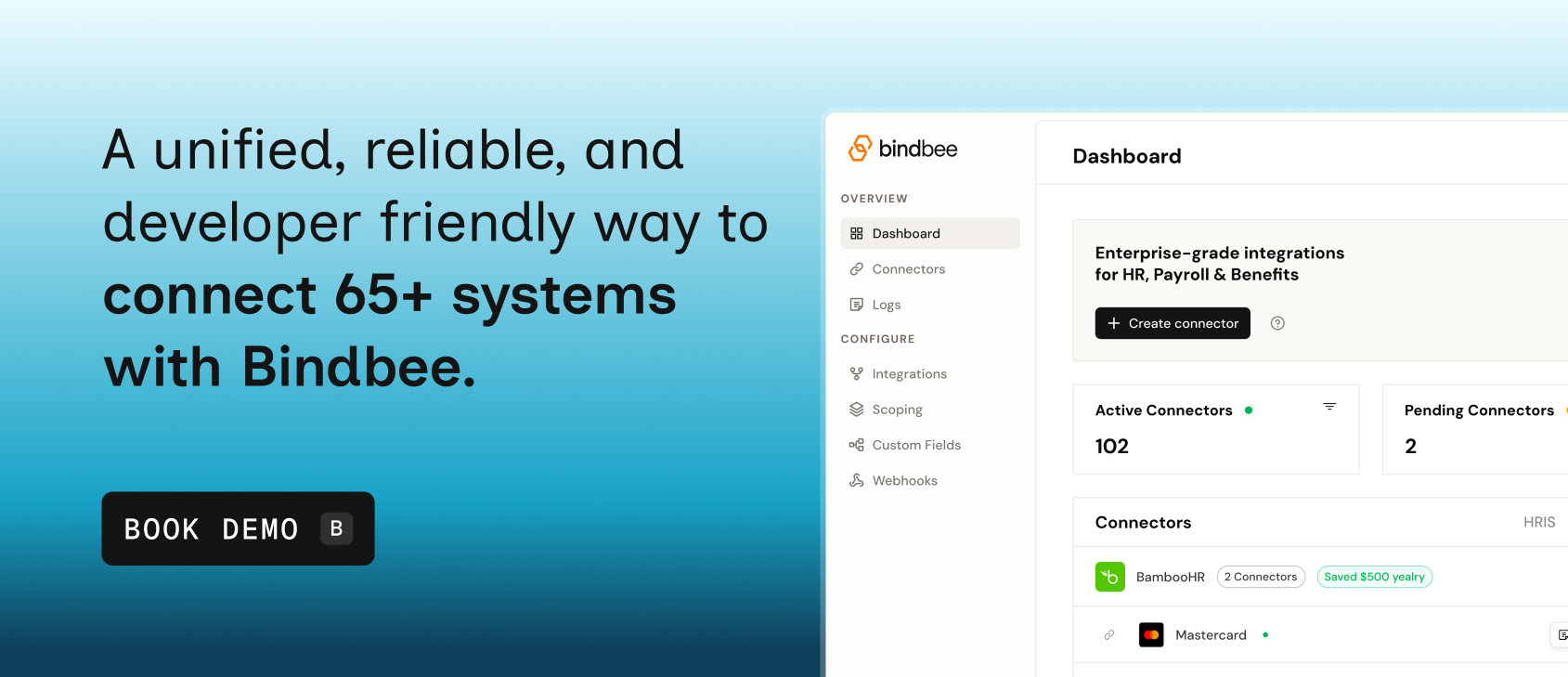
Bindbee normalizes data across 65+ HRIS and payroll systems including Workday, ADP, UKG, Rippling, BambooHR, Gusto, Paychex, and more. One integration. Consistent schema. Ongoing maintenance handled by Bindbee as vendor APIs change.
How to Choose
- Building a general SaaS product that needs to connect to many different app types: Paragon or Unified.to.
- Building an HR Tech or benefits platform where deep HRIS/payroll integration is core to your product: Bindbee.
- Need write-back support (deductions, contributions, enrollment updates back to HRIS): Bindbee, which has pre-negotiated write access across 65+ systems.
Book a demo to see how a Unified API approach can accelerate your integrations.