

Top Workato Alternatives for 2025
Summarise the blog with AI
.avif)
You’re no stranger to the frustration that comes with trying to get your systems to talk to each other. HR platforms, payroll systems, benefits tools, and various SaaS solutions all contain critical data, but connecting them is anything but seamless.
Workato is a powerful integration platform, but it’s built for horizontal workflow automation — not the deep HRIS and payroll connectivity that HR Tech and benefits companies need. This guide covers the main alternatives and when each makes sense.
Key Highlights:
- Workato is a horizontal iPaaS best suited for enterprise workflow automation across many different application types.
- For HR Tech and benefits platforms that need deep HRIS and payroll connectivity, vertical unified APIs are the more appropriate architecture.
- The right alternative depends on use case: internal IT automation, embedded integrations for B2B SaaS, or product-specific HRIS coverage for HR Tech.
- Bindbee is built specifically for HR — 65+ HRIS and payroll systems, deep benefits data models, and write-back support that horizontal tools don’t provide.
What Workato Does Well (and Where It Falls Short)
Workato is a strong platform for enterprise IT teams that need to automate workflows across ERP, CRM, ITSM, and communication tools. Its recipe-based automation, pre-built connectors, and enterprise security features make it a solid choice for operations teams with broad, heterogeneous integration needs.
Where it falls short for HR Tech:
- Generalist HRIS connectors: Workato’s HRIS connectors expose basic employee fields, not the benefits-specific objects (dependents, deductions, enrollment elections, payroll runs) that HR Tech workflows require.
- No write-back to payroll: Horizontal automation platforms typically don’t have pre-negotiated write access to payroll systems. Pushing deduction changes to ADP or UKG isn’t what Workato is built for.
- Per-customer complexity: Building multi-tenant integrations where each customer has their own HRIS connection is operationally complex on Workato. Each customer’s connection requires separate setup and management.
- Cost at scale: Workato’s pricing is designed for enterprise IT teams, not for B2B SaaS products that need to support dozens or hundreds of customer HRIS connections.
Alternatives to Workato for Different Use Cases
For internal IT automation: Make, Zapier, n8n
If you need workflow automation across SaaS tools without Workato’s enterprise pricing, Make (formerly Integromat), Zapier, and n8n offer similar trigger-action automation with broader accessibility. These are horizontal platforms that work well for internal productivity automation.
For embedded B2B SaaS integrations: Paragon, Merge
If you’re building a SaaS product that needs to let customers connect their own tools through an embedded UI, Paragon offers white-labeled integration workflows. Merge provides a unified API for HRIS, ATS, and CRM data across multiple categories. Both are better fits for product integrations than Workato.
For HR Tech and benefits platforms: Bindbee
If your product is specifically HR Tech or benefits and you need deep HRIS and payroll connectivity, Bindbee is built for this use case. Key differences from Workato:
- HR-specific data depth: 65+ HRIS and payroll systems with normalized data models covering employees, compensation, dependents, benefits enrollment, deductions, payroll runs, and pay groups.
- Write-back support: Pre-negotiated write access across Bindbee’s connector network. Push deduction changes, enrollment updates, and 401(k) contributions back to payroll — what benefits platforms actually need.
- Multi-tenant architecture: Built for B2B SaaS products where each customer has their own HRIS connection. Bindbee manages per-customer auth, tokens, and sync health automatically.
- SFTP coverage: HRIS and payroll vendors that still use file-based exports are normalized through Bindbee’s SFTP adapters and served through the same API as modern REST connectors.
Build vs. Buy for HRIS Integration
Building HRIS integrations in-house is one of the most common ways HR Tech companies slow down their roadmap:
- 4–8 weeks per integration initially
- Ongoing maintenance as vendor APIs change
- $200K–$500K annually for companies with 15+ integrations
- Integration incidents that create customer support tickets and renewal risk
The alternative: integrate once with Bindbee and get normalized access to 65+ systems. Maintenance shifts to Bindbee’s team. Your engineering focuses on product.
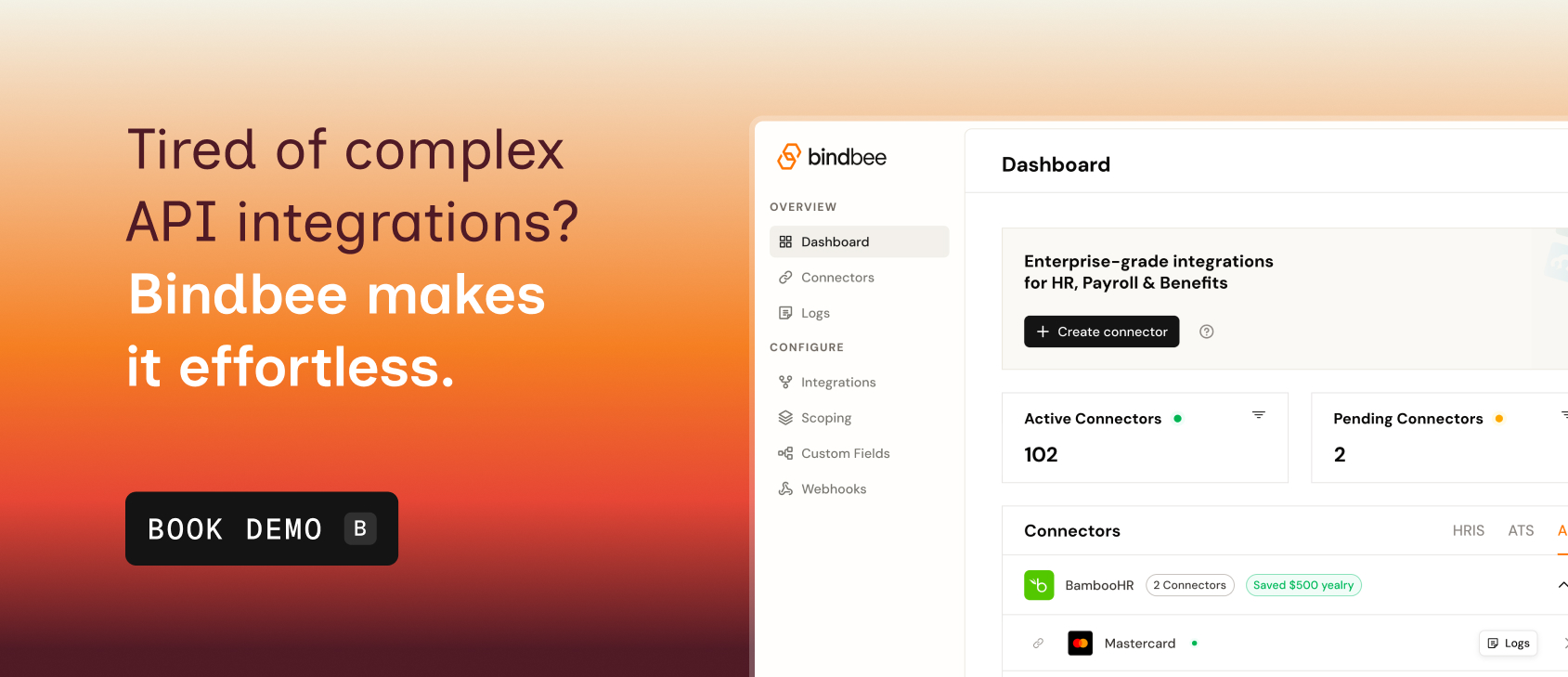
Book a demo to see how Bindbee covers 65+ HRIS and payroll integrations for HR Tech products.