

Best Practices for B2B API Integration
Summarise the blog with AI
Most B2B API integration guides focus on individual API calls. This one focuses on the patterns that determine whether your integration layer scales or becomes a maintenance liability. If you're supporting HRIS integrations across multiple customers on different platforms, the decisions covered here directly affect your engineering capacity and deal velocity.
Key Highlights
- B2B API integration best practices aren’t about individual endpoints — they’re about architecture decisions that determine how your integration layer behaves at scale.
- The most expensive integration mistake isn’t the initial build — it’s the ongoing maintenance cost that compounds as you add more systems.
- Normalization, multi-tenancy, and observability are the three design decisions that separate scalable integrations from technical debt.
- Bindbee provides 65+ HRIS and payroll integrations with normalized data models built for multi-tenant B2B SaaS products.
The Three Decisions That Determine Scale

1. Normalize at Ingestion, Not at Query
The most common integration architecture mistake is storing vendor-specific data structures directly in your database. When you store Workday’s internal field names or ADP’s nested response format, you create tight coupling: every vendor API change becomes a database migration, and your product code has to handle multiple data shapes.
Instead, build a normalization layer that maps all vendor data to your schema at ingestion. The benefits:
- Vendor API changes only touch the normalization layer, not your product logic
- Your product code queries one consistent schema regardless of source system
- Adding a new HRIS system only requires building the normalization map, not updating product code
2. Build Multi-Tenancy Into the Integration Layer
In B2B SaaS, each customer has their own HRIS connection with their own credentials. This isn’t an edge case to handle later — it’s the default operating condition.
Multi-tenant integration requires:
- Per-customer credential isolation: OAuth tokens and API keys stored separately per customer, never shared or co-mingled
- Per-customer sync state: Track what’s been synced per customer independently. One customer’s failed sync shouldn’t block or affect another’s.
- Per-customer error handling: Errors surface to the right customer context, not as undifferentiated system failures
- Per-customer configuration: Different customers may need different field mappings, sync schedules, or data scoping
3. Build Observability for Write Operations Specifically
Read failures are usually UI inconveniences. Write failures can be compliance issues — a deduction that didn’t reach payroll, an enrollment that didn’t update. Treat write observability differently from read observability:
- Track write operation status per record, not just per sync run
- Alert on first write failure, not after N consecutive failures
- Maintain an audit trail of what was written, when, and by whom
- Build explicit retry logic for write failures with backoff and dead letter handling
The Maintenance Cost That Changes the Build-vs-Buy Decision
Most teams evaluate HRIS integration build-vs-buy on initial build time: 4–8 weeks per integration. That’s accurate but incomplete. The ongoing maintenance cost changes the math:
- Workday deprecates a SOAP endpoint — engineering sprint required
- ADP rotates OAuth token structure — sync fails until patched
- UKG releases a new API version — field mappings break
- Gusto changes deduction write endpoint — benefits workflow stops
At 15+ integrations, each of these events is not hypothetical — they happen regularly. The annual maintenance cost for 15 integrations is typically $200K–$500K in loaded engineering cost, before counting the opportunity cost of engineers not building product.
How Bindbee Implements These Patterns
Bindbee provides 65+ HRIS and payroll integrations with these patterns built in:
- Normalized data models: Every HRIS system maps to Bindbee’s standard schema — employees, compensation, benefits enrollment, dependents, deductions, payroll runs, pay groups. Your product queries one schema regardless of source system.
- Multi-tenant auth management: Bindbee handles per-customer OAuth token provisioning, refresh, and isolation. Your engineering team doesn’t manage credentials.
- Vendor maintenance absorbed: When Workday deprecates an endpoint or ADP changes their OAuth flow, Bindbee updates the connector. Your integration doesn’t break.
- Write-back with pre-negotiated access: Bindbee has pre-negotiated write access across its connector network. Push deductions, enrollment updates, and contributions to payroll without the partner program wait.
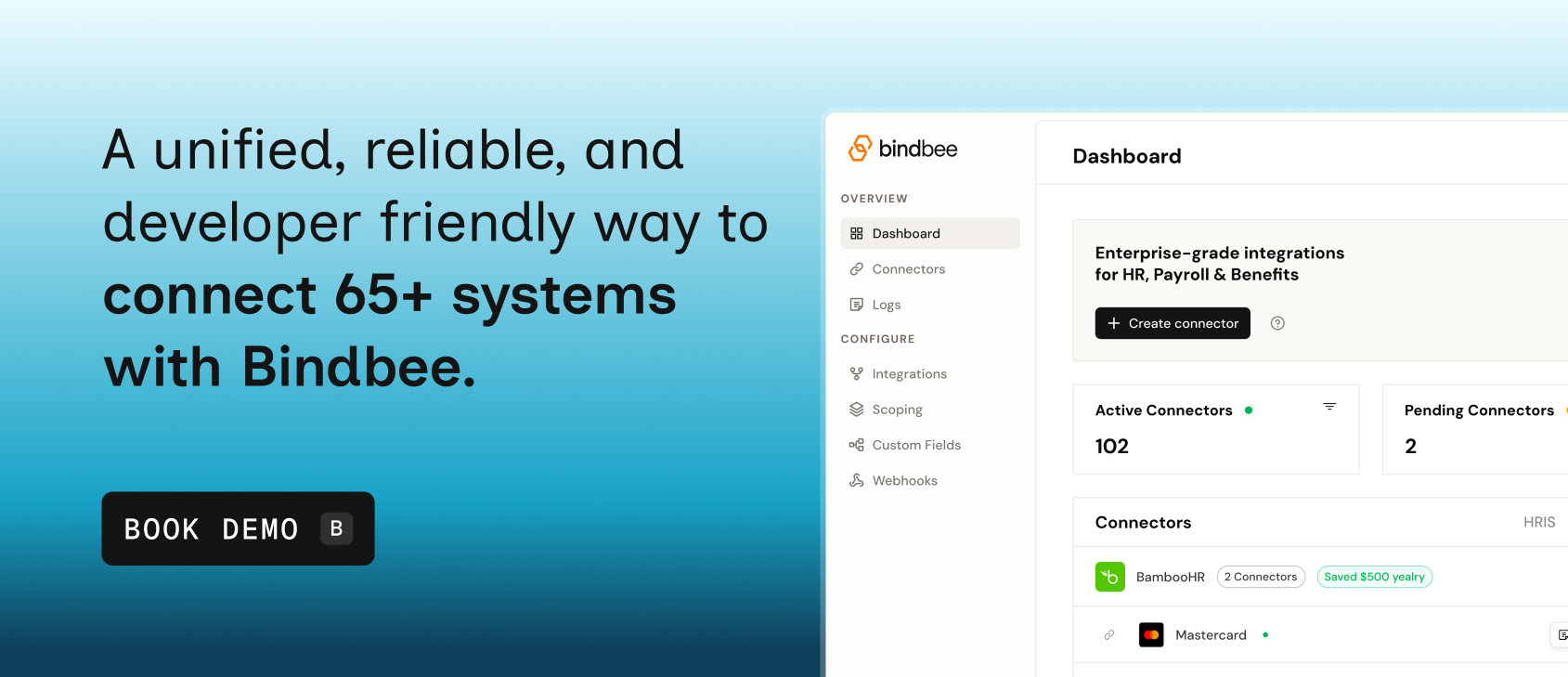
Book a demo to see how Bindbee’s 65+ HRIS and payroll integrations implement these B2B API best practices.