

Data Residency as a Hard Requirement: What Has to Stay In-Region, and How to Prove It
Summarise the blog with AI
Key takeaways
- Residency, sovereignty, and localization are three different demands. Pin down which one you're holding before you evaluate any vendor.
- "Hosted in-region" describes primary storage only. Backups, logs, search indexes, disaster-recovery replicas, encryption keys, and subprocessors each need the same answer independently.
- Storage location and personnel access are two separate controls. A vendor can satisfy one and fail the other.
- Employee data draws scrutiny that customer data often doesn't: SSNs and dependent records in scope, works councils in the EU, and payroll data that crosses borders as a functional necessity.
- Your integration layer is a subprocessor on the list your customer is auditing. Its answers become your answers.
- GDPR regulates transfers rather than banning them. Regimes like China's PIPL and the DFARS clause for DoD cloud data can mandate actual in-country storage.
- Most "our data can't leave the jurisdiction" requirements are scopeable. Narrowing the dataset resolves more of these than moving infrastructure does.
What has to stay in-region when a customer says employee data can't leave the jurisdiction
A customer tells you employee data cannot leave a specific jurisdiction. Your integration vendor tells you it hosts data in that same region. Those two sentences sound like agreement, and they are answering different questions.
Region selection controls where the primary database physically sits. It says nothing about the backup that replicates to a second data center, the support engineer who can query the record from another country, or the subprocessor two steps removed from the vendor's own infrastructure. Even privacy law reflects the gap. GDPR does not require European personal data to stay inside Europe. It regulates the transfer of that data outside the EEA, permitting it under an adequacy decision, contractual safeguards, or a specific derogation (European Commission, rules on international data transfers).
If you run a benefits or HR-tech platform, this question arrives at you from two directions at once. Your employer and TPA customers ask it of you. And because your integration layer holds the same employee data you do, you have to be able to answer for it too. This guide covers what has to stay in-region when residency is a hard line, why employee data specifically draws a harder look, how the requirement changes by jurisdiction, the exact questions that prove a vendor meets it, and what to do when one doesn't.
Residency, sovereignty, and localization are three different asks
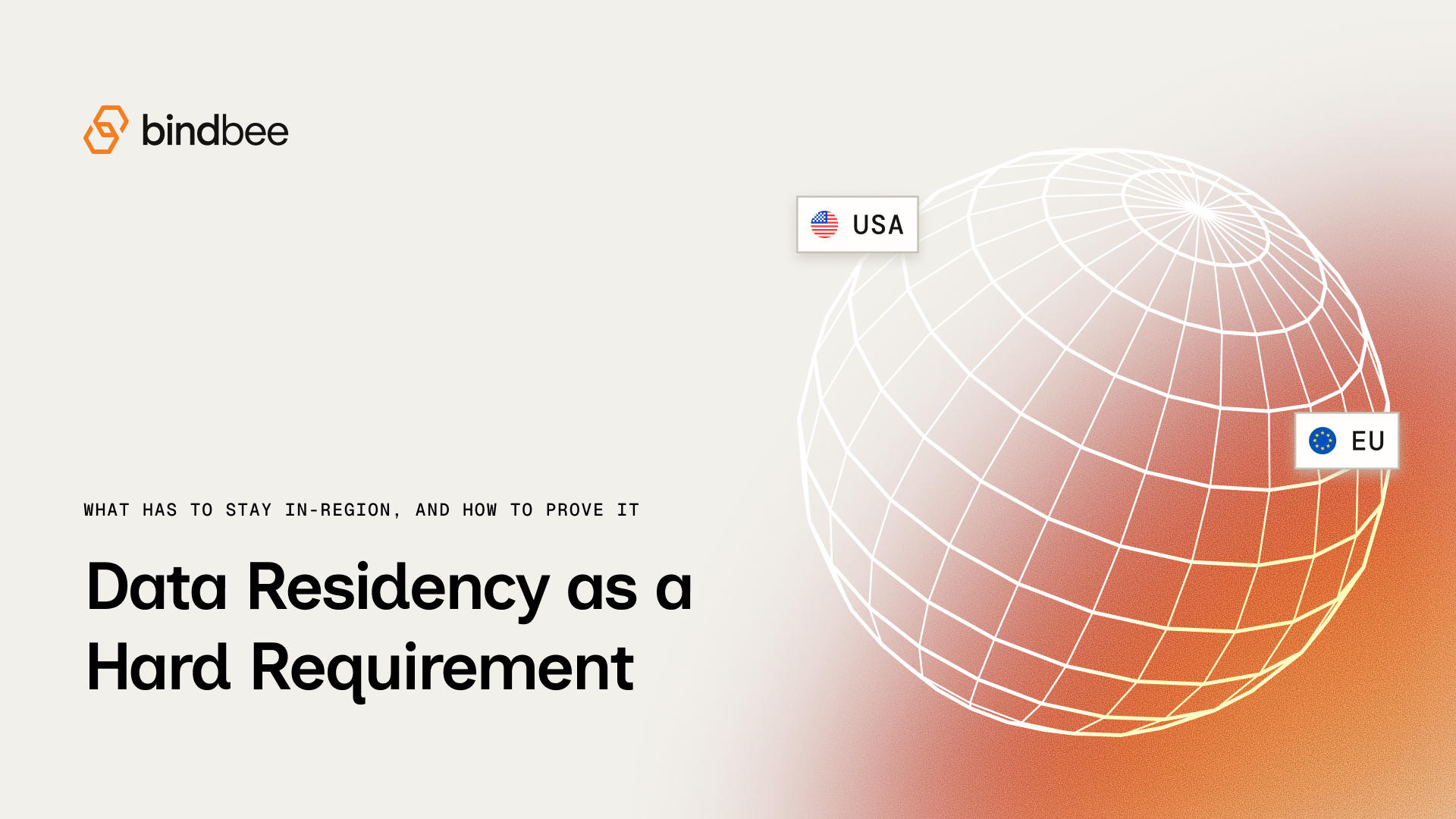
Data residency is about physical location: where the bytes are stored at rest. Data sovereignty is about legal control: whose laws apply and which government can compel access, wherever the data happens to sit. Data localization is the strictest. It is a legal mandate that specific data cannot leave a country's borders at all, sometimes barring even a compliant copy stored elsewhere.
The confusion between the three does real work against you. A customer saying "our employee data can't leave the jurisdiction" might mean a residency preference, a sovereignty concern about a foreign government's reach into your vendor, or an actual localization mandate. Each demands a different answer. Naming which one you're holding decides which questions below matter and which don't.
Why employee data gets a harder look than customer data
A residency conversation about marketing contacts and a residency conversation about employee records are not the same conversation, and the second one is the one you're in.
The payload is the most sensitive category you handle. A census or HRIS record carries names, national identifiers, dates of birth, home addresses, dependents, and coverage elections. In the US, health plan elections drag HIPAA into it. HIPAA itself imposes no residency requirement. A BAA is about safeguards and permitted uses, not geography, so a customer's residency line comes from their contract or their own regulator, not from HIPAA. Those two obligations sit on the same data and are satisfied separately. A vendor that has signed a BAA has told you nothing about where the data lives.
EU employee data has its own machinery. Employee personal data processing in several EU member states runs through works council consultation, and the imbalance of power between employer and employee is a standing reason regulators treat employment data as higher-risk. A DPIA that would be optional for customer analytics is often expected for employee monitoring and HR systems. So an EU employer asking where employee data sits may be asking on behalf of a works council that has to approve the arrangement, not just a procurement checklist.
Multi-country payroll moves data across borders as a functional necessity. Paying someone in one country from a parent entity in another means the data crosses a border because the business process crosses a border, not because someone chose an architecture. Residency in that setting is a scoping exercise about which fields have to stay, not a yes or no about a region.
And your integration layer is on the list. Your customer's checklist asks which subprocessors touch this data and where they are. For every one of your customers, your unified API or integration vendor is a row on that list. Whatever you can't answer about it becomes an answer you can't give.
Why "hosted in-region" doesn't answer the question
A vendor says its production database for US customers runs in a US cloud region. That claim is true and it is a fraction of the picture. The nightly backup might replicate to a different region for redundancy. The search index powering the vendor's own support tooling might live in a shared multi-region cluster. Application logs often flow through a pipeline that was never scoped for residency at all.
A hard residency requirement follows the data everywhere it goes. Beyond primary storage, six other surfaces need the same answer:
- Backups and snapshots, often retained on a different schedule, and sometimes in a different region, than production
- Logs and telemetry, which frequently route through a shared observability or analytics pipeline
- Search indexes and caches, which duplicate data outside the system of record for performance
- Disaster-recovery replicas, which by design exist in a second location
- Encryption keys, since a key held outside the jurisdiction can undermine the protection the location was meant to provide
- Subprocessors, meaning any third-party service the vendor relies on to deliver the product
Missing one of these is survivable if the customer's requirement is a soft preference. If it's contractual, the next audit or subpoena won't care which layer of the stack held the data.
The two questions a residency requirement is actually asking
Underneath "employee data can't leave the jurisdiction" are two separate demands, and a vendor who answers one has not answered the other.
Where is the data stored? That covers the physical location of primary storage and every one of the six surfaces around it.
Who can access it, and from where? That is a different control entirely. Data stored entirely within the correct jurisdiction can still be queried by a support engineer, an on-call SRE, or an outsourced operations team sitting somewhere else.
A vendor that stores every byte inside the required country and lets a globally distributed support team query production data has satisfied the storage half of the requirement and failed the access half. Most residency claims don't say which one they're describing, so it's on the buyer to ask both, separately.
How the requirement changes by jurisdiction
US federal contracts can turn residency into a literal, contractual mandate. Under the DFARS clause governing DoD cloud computing, 48 CFR 239.7602-2, a cloud provider handling government data must keep all of it that is not on DoD premises within the fifty states, the District of Columbia, or a US outlying area, unless the government specifically authorizes otherwise (eCFR, 48 CFR 239.7602-2). That's a contract term with a defined geographic boundary.
China's Personal Information Protection Law goes further for a narrower category. Article 36 requires personal information handled by state organs to be stored inside China's territory, and any transfer abroad requires a security assessment first (China's PIPL, Art. 36). This is what true localization looks like: a legal floor rather than a default a contract can waive.
The EU sits at the other end. The EU-US Data Privacy Framework, an adequacy decision adopted on 10 July 2023, lets personal data move from the EU to certified US organizations without extra safeguards, and the EU General Court upheld its validity on 3 September 2025 in Latombe v Commission (T-553/23) (European Commission, Implementing Decision 2023/1795). Latombe appealed on 31 October 2025, and that appeal, Case C-703/25 P, is pending before the Court of Justice as of 25 August 2026. The DPF is a valid transfer mechanism today, and it is under active review by the same court that struck down Privacy Shield. Worth knowing before you build a residency answer that rests on it alone.
Three regimes, three different answers to the same customer sentence. A requirement rooted in a DoD contract or China's PIPL is asking for actual localization. A requirement rooted in GDPR is asking about a lawful transfer mechanism, which a vendor can usually satisfy without moving a single server.
The vendor checklist: nine questions that prove residency
Turn the two controls into questions a vendor has to answer specifically. "Yes, we support residency" isn't an answer to any of these.
On where the data is stored:
- Which region hosts primary storage for this data, named specifically, not by marketing category?
- Where do backups and snapshots replicate to, and on what schedule?
- Where does disaster recovery fail over to, and does that change the jurisdiction?
- Do logs, search indexes, or analytics pipelines route data outside the primary region?
- Where are the encryption keys held, and who controls them?
On who can access it:
- Where are support and engineering staff located, and can anyone outside the jurisdiction query production data?
- Which subprocessors touch this data, and where are they located?
- Is offshore access technically blocked, or only discouraged by policy?
- What happens to the commitment if a subprocessor's own jurisdiction changes?
A vendor's answers are only as durable as the contract behind them. A data processing addendum is where a vendor states contractually what it commits to on storage, transfers, and subprocessors, and that holds up in a way a hosting page never will. Ask to see it, and check it against what you were told.
If you're assembling this alongside the rest of a diligence pack, it belongs with the other artifacts a counterparty asks for. See what a vendor security and compliance review actually covers for the stages this sits inside.
Most residency requirements are scopeable
The opening premise of this page is that the customer's sentence is imprecise. The move that follows from it: a large share of "employee data can't leave the jurisdiction" resolves to "these four fields can't leave the jurisdiction" once someone asks.
Before you re-architect anything, work the scope.
- Narrow the dataset. National identifiers, dependent records, and compensation are usually what the requirement is really about. Demographic and employment-status fields often aren't. Pseudonymizing or tokenizing the sensitive subset can put the rest of the pipeline back in scope.
- Separate storage from access. Sometimes the answerable version is "stored in-region, and offshore access technically blocked," which is a control you can implement without moving infrastructure.
- Find out where the requirement came from. A works council, a regulator, a customer contract, and an internal policy have very different amounts of give in them.
What to do when a vendor fails the checklist
Failing is common and it is not automatically fatal. What matters is which question they failed and whether the gap is closeable.
- Get the gap in writing, with a date. A remediation commitment in the MSA with a delivery date is a different risk than a verbal "it's on the roadmap."
- Ask for a contractual carve-out covering the specific surface that fails, plus audit rights to verify it.
- Re-scope rather than replace, using the narrowing above, if the failure is on a field set you can pull out of scope.
- Check whether the tier is the problem. Residency is often available on a different deployment model (single-tenant, on-prem, or a regional endpoint) rather than absent from the product.
- Walk when the failure is on access and there's no technical control. "We discourage it by policy" against a hard contractual line is the one that tends not to survive an audit.
What residency-capable infrastructure looks like
Vendors built for hard residency requirements share a shape: regional deployment tied to real infrastructure boundaries rather than a marketing label, and a tenancy model, usually single-tenant or logically isolated multi-tenant, that keeps one customer's data out of another's storage layer by default. Major cloud providers supply the regional building blocks. What a vendor does with them is a separate question.
Here is where Bindbee sits, in the terms this page has been using. Our DPA is available on request, and it is where the commitments on processing, transfers, and subprocessors actually live. We sign a BAA as standard where PHI is in scope. We hold SOC 2 Type II and ISO 27001, and data is encrypted in transit with TLS 1.2 or higher and at rest with AES-256.
On deployment, multi-tenant SaaS is the default. Single-tenant, on-prem, and BYOC are available for buyers with strict data, security, or residency requirements. That tier is where storage location becomes something you specify rather than inherit.
The nine questions go further than any trust center page answers, including ours. We answer them in writing during security review, per deployment model, because the answers are different for multi-tenant and BYOC. If you are holding a residency line, send us the nine and check what comes back against the DPA.
Region selection was never the finish line. It's the first checkbox on a longer list: storage, backups, logs, replicas, keys, subprocessors, and the people who can reach all of it. A vendor that can answer for every one of those, in a contract, has met a hard residency requirement. One that answers for the primary database and stays quiet about the rest has met a marketing claim.
Book a demo if you want to walk your own residency requirement through this list.
FAQ
What is the difference between data residency and data sovereignty?
Residency is about physical location: where data is stored. Sovereignty is about legal jurisdiction: whose laws govern the data and which government can compel access, regardless of where it sits. A vendor can satisfy residency while the company holding the data remains subject to a foreign government's sovereignty claim.
Does GDPR require employee data to be stored in Europe?
No. GDPR Chapter V regulates transfers of personal data outside the EEA and permits them under an adequacy decision, appropriate safeguards such as standard contractual clauses, or a specific derogation. Employee data is not carved out of that. What is different about employee data is the scrutiny it draws: works council consultation and DPIA expectations often apply where they wouldn't for customer data.
Does HIPAA impose a data residency requirement?
No. HIPAA sets safeguard and permitted-use obligations and requires a business associate agreement before PHI moves, but it does not require PHI to stay inside the United States. A residency requirement on health data comes from a customer's contract or another regulator, and it has to be satisfied separately from the BAA.
Can EU employee data be stored in the US?
Yes, under a valid transfer mechanism. The EU-US Data Privacy Framework, upheld by the EU General Court on 3 September 2025, is the main current mechanism alongside standard contractual clauses. The appeal against that ruling (C-703/25 P) is pending before the Court of Justice as of August 2026, so a residency answer resting on the DPF alone carries a known tail risk.
What is the difference between data localization and data sovereignty?
Localization is a legal mandate that data must stay within a country's borders, sometimes barring even a compliant copy elsewhere. Sovereignty is broader: which laws and which government's authority apply wherever the data lives. China's PIPL Article 36 is a localization rule. Sovereignty concerns can exist with no localization law at all.
How do I prove a vendor meets a residency requirement?
Ask the nine questions above, five on storage surfaces and four on access, and get specific answers rather than a region label. Confirm the commitment appears in the data processing addendum rather than only on a hosting page. If the vendor is an integration layer, remember that it becomes a subprocessor row on your own customer's audit, so their answers have to be good enough to pass along.