

A Guide to Using Employee APIs
Summarise the blog with AI
Managing employee data across multiple HR, payroll, and benefits systems is often more complicated than it seems. Organizations frequently deal with fragmented systems, inconsistent data formats, and delayed updates, which not only consume engineering resources but also create operational risk.
In fact, 95% of IT leaders say integration issues are limiting the impact of their AI and digital transformation investments. For HR Tech and benefits platforms, this directly translates to slower product delivery, manual workarounds, and the constant pressure of maintaining integrations that break when HRIS vendors change their APIs.
This guide covers what employee data API integration actually requires and how to approach it at scale.
Key Highlights:
- Employee data API integration connects HR, payroll, and benefits systems to enable real-time synchronization of employee records, compensation, enrollment, and deductions.
- The challenge isn’t one integration. It’s building and maintaining integrations across the 15–20 HRIS platforms your customers use, each with different APIs, auth flows, and field schemas.
- Unified APIs like Bindbee normalize employee data across 65+ HRIS and payroll systems through one integration, eliminating per-system development and ongoing maintenance.
- Deep data coverage matters. HR Tech products need more than basic employee profiles — they need compensation, dependents, benefits enrollment, payroll runs, and write-back support.
What Employee Data APIs Actually Expose

Modern HRIS and payroll platforms expose employee data through REST APIs, SOAP services, or SFTP-based file exports. The core data categories:
- Employee profiles: Personal information, contact details, employment status, job titles, hire and termination dates.
- Compensation: Base salary, hourly rate, pay frequency, pay grade, effective dates, and compensation history.
- Org structure: Department, location, supervisory hierarchy, cost centers, and pay groups.
- Benefits enrollment: Plan elections, coverage levels, effective dates, dependent details, and waiver records.
- Payroll data: Pay runs, earnings breakdowns, deductions, tax withholdings, and pay stubs.
- Time off: Leave requests, balances, accrual policies, and absence records.
- Dependents: Spouse, child, and domestic partner information for benefits eligibility.
The challenge is that every HRIS platform exposes this data differently. Workday, ADP, UKG, BambooHR, Rippling, and Gusto each have different field names, data structures, authentication mechanisms, and API patterns.
Common Integration Patterns
Direct HRIS API Integration
Building directly to each HRIS vendor’s API gives you full control but comes at high cost. Each integration requires:
- Partner program registration and API access approval (often 4–12 weeks)
- Per-customer OAuth token management
- Custom field mapping between vendor schemas and your data model
- Ongoing maintenance as vendor APIs change
- Separate webhook configurations for real-time sync
This model works for 1–2 integrations. At 10–20, it becomes a full-time maintenance operation.
Unified API
A unified API normalizes employee data across all HRIS platforms behind a consistent interface. You integrate once; the unified API handles the per-system complexity.
For HR Tech and benefits platforms, this means:
- One API call returns the same employee data structure whether your customer is on Workday or Gusto
- Write operations (deduction updates, enrollment changes) work across all connected systems
- Vendor API changes are handled by the unified API layer, not your engineering team
The Write-Back Problem
Reading employee data is challenging. Writing back is harder.
Benefits deductions, 401(k) contributions, and enrollment elections need to flow from your platform into the payroll system. This requires write access, which most HRIS vendors restrict to formal partners. The approval process can take months and varies significantly by vendor.
Platforms that build direct often discover this late: they can pull employee data but can’t push deduction changes back, requiring manual processes that defeat the purpose of the integration.
How Bindbee Handles Employee Data API Integration
Here’s how we can help you:
- Prebuilt Connectors to 65+ Platforms: Bindbee provides pre-built, maintained connectors to Workday, ADP, UKG, Rippling, BambooHR, Gusto, Paychex, Paylocity, Paycom, Bob, Personio, Factorial, and more. SFTP adapters handle legacy file-based vendors.
- Normalized Data Models: 16–17 standardized objects per integration: employees, compensation, benefits enrollment, dependents, payroll runs, time-off, pay groups, org structure. Consistent schema regardless of source system.
- Read and Write Support: Pull employee data and push deduction changes, enrollment updates, and contribution rates back to the HRIS. Write access pre-negotiated across Bindbee’s connector network.
- Real-Time Webhooks: Event-driven updates for new hires, terminations, compensation changes, and benefits events. No polling delays.
- Multi-Tenant Auth Management: Bindbee handles OAuth token provisioning, refresh, and per-customer connection management. Your engineering team doesn’t manage credentials.
- Operational Dashboards: Visibility into sync status, data errors, and affected employees — without building your own observability layer.
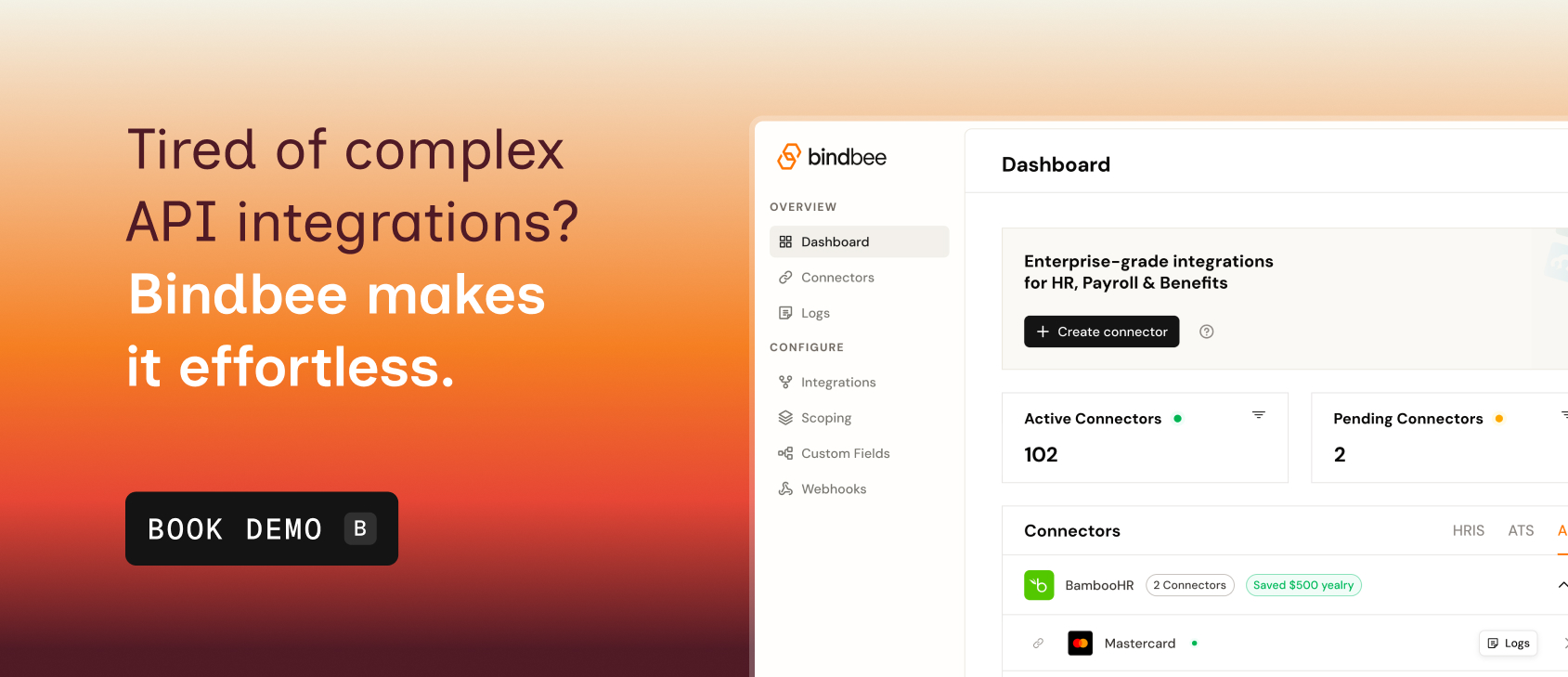
Book a demo to see how Bindbee normalizes employee data across 65+ HRIS and payroll systems.