

How Integrated HRMS Boosts Efficiency?
Summarise the blog with AI

Your HR team likely uses several tools and software every day. When payroll sits in one platform, attendance in another, and employee data in spreadsheets, your team spends hours switching tools and manually entering data. Integrated HRMS solves this by connecting these systems so data moves automatically, without manual intervention.
This guide covers what integrated HRMS looks like in practice and what it actually takes to build it at scale for HR Tech products.
What Integrated HRMS Actually Means
HRMS integration isn’t just about pulling employee data. A fully integrated HRMS environment means:
- Bidirectional data flow: Changes in one system automatically propagate to connected systems. A new hire in the HRIS triggers benefits enrollment. A benefits election updates payroll deductions.
- Real-time sync: Data doesn’t wait for scheduled batch exports. Events trigger updates immediately.
- Normalized data: The same field means the same thing regardless of which HRMS it came from. “Employee Status” in Workday, ADP, and BambooHR all map to the same value in your system.
- Error visibility: When syncs fail, your team knows immediately, can see which customers and employees are affected, and can resolve issues without opening engineering tickets.
The Multi-HRMS Problem
If you’re building HR Tech, you don’t integrate with one HRMS. You integrate with all of them. Your customer base is spread across Workday, ADP Workforce Now, ADP Run, UKG Pro, UKG Ready, BambooHR, Rippling, Gusto, Paychex Flex, Paylocity, Paycom, Bob (HiBob), Personio, and dozens of others.
The conventional approach: build integrations one by one as customers request them. The cost: 4–8 weeks per integration, ongoing maintenance as vendor APIs change, and engineering bandwidth permanently allocated to integrations instead of product.
At scale, this model breaks. Benefits platforms report spending $200K–$500K annually just maintaining HRIS integrations that aren’t core product differentiation.
How Bindbee Enables Integrated HRMS for HR Tech Products
Bindbee provides a unified API that normalizes HRMS data across 67+ systems. Here’s how we can help you:
- Single API: Connect once and access HRIS, payroll, benefits, and carrier systems, eliminating the need to build and maintain individual integrations.
- Deep Data Models: 16–17 normalized objects per integration covering employees, compensation, benefits enrollment, dependents, payroll runs, time-off, pay groups, and more. Not just employee names and emails.
- Real-Time Sync: Event-driven webhooks and automated polling keep data consistent. Hire events, terminations, compensation changes, and enrollment updates sync immediately.
- Write-Back Support: Push deduction changes, contribution updates, and enrollment data back to the HRIS without building separate write integrations for each platform.
- Operational Tooling: Dashboards showing sync status, error logs, and affected employees. Non-technical teams can identify and resolve data issues without engineering support.
Real-World Impact
Papershift, a workforce management platform, reduced integration deployment time from 90 days to under 24 hours after connecting to Bindbee. Newfront, an insurance brokerage, reduced enterprise onboarding time from 8–12 weeks to 48 hours. Clever Benefits saved $80,000 annually in integration maintenance costs.
These outcomes come from treating HRMS integration as infrastructure rather than a project: one integration deployed once, covering the entire HRIS category.
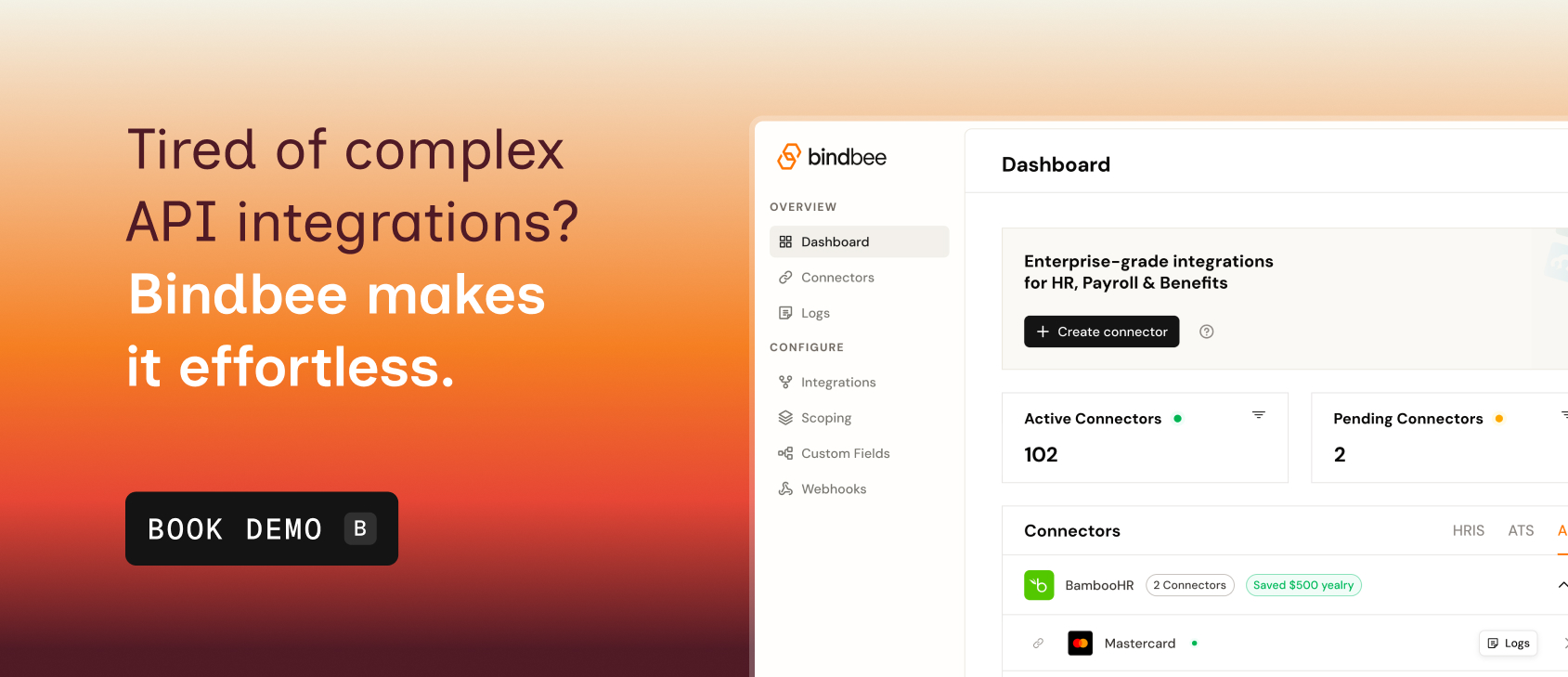
Book a demo to see how Bindbee handles integrated HRMS connectivity across 67+ systems.