

Integration Best Practices: A Comprehensive Guide
Summarise the blog with AI

Your product roadmap isn't the problem; your integrations are. Supporting dozens of HRIS systems individually creates a maintenance burden that compounds over time. This guide covers the integration patterns that actually scale and how to implement them.
Key Highlights:
- The highest-leverage integration best practices aren't about individual API calls — they're about architecture decisions that determine whether your integration layer scales or becomes a liability.
- The biggest hidden cost in HRIS integration isn't the initial build — it's ongoing maintenance as vendor APIs change.
- Unified APIs reduce per-system complexity by normalizing multiple systems behind one interface.
- Bindbee provides 67+ pre-built HRIS and payroll integrations with normalized data models built for HR Tech products.
Architecture Decisions That Scale
1. Normalize Early, Not Late
The single biggest integration architecture mistake is storing vendor-specific data structures in your database. When you store Workday's internal field names or ADP's nested response format directly, you create a tight coupling that makes every vendor API change a database migration.
Build a normalization layer between the vendor API and your data model. Every HRIS system maps to your schema at ingestion, not at query time. This means:
- Vendor API changes only affect the normalization layer
- Your product code queries a consistent schema regardless of source system
- Adding a new HRIS vendor only requires updating the normalization layer
2. Design for Multi-Tenancy From Day One
B2B SaaS products face a challenge that internal tools don't: each customer has their own HRIS connection with their own credentials, their own data model quirks, and their own sync requirements.
Multi-tenant integration architecture requires:
- Per-customer credential storage (OAuth tokens, API keys)
- Per-customer sync configuration and scheduling
- Isolated error handling so one customer's failed sync doesn't affect others
- Per-customer observability so you can diagnose issues without exposing other customers' data
Building this from scratch for each integration is expensive. Platforms like Bindbee handle multi-tenant auth management as part of the unified API layer.
3. Build Idempotent Sync Operations
Network failures, timeouts, and partial syncs happen. Your integration logic needs to handle running the same sync operation multiple times without creating duplicate records or corrupting data.
Idempotency in practice:
- Use external IDs from the source system as your unique keys, not auto-incremented database IDs
- Track sync state per record, not just per sync run
- Handle partial failures gracefully — a failed employee record shouldn't abort the entire sync
4. Implement Webhook-First Where Available
Polling HRIS APIs for changes is expensive: API rate limits, latency for new hire detection, and compute cost for unchanged data. Most modern HRIS platforms offer webhooks for real-time event notification.
Webhook-first architecture:
- Subscribe to new hire, termination, and compensation change events
- Use polling only for initial data load or systems without webhook support
- Build idempotent webhook handlers to handle duplicate delivery
5. Separate Read and Write Paths
Reading employee data and writing back deductions or enrollment changes are fundamentally different operations with different reliability requirements. A write failure that prevents a benefits deduction from reaching payroll is a compliance issue. A read delay is a UI inconvenience.
Keep read and write operations separate:
- Write operations should have explicit retry logic and failure alerting
- Read operations can be eventually consistent; write operations often cannot
- Track write operation status per record so you can diagnose and retry failures
Bindbee for Scalable HRIS Integration
Bindbee implements these patterns across 67+ HRIS and payroll integrations so your engineering team doesn't have to.
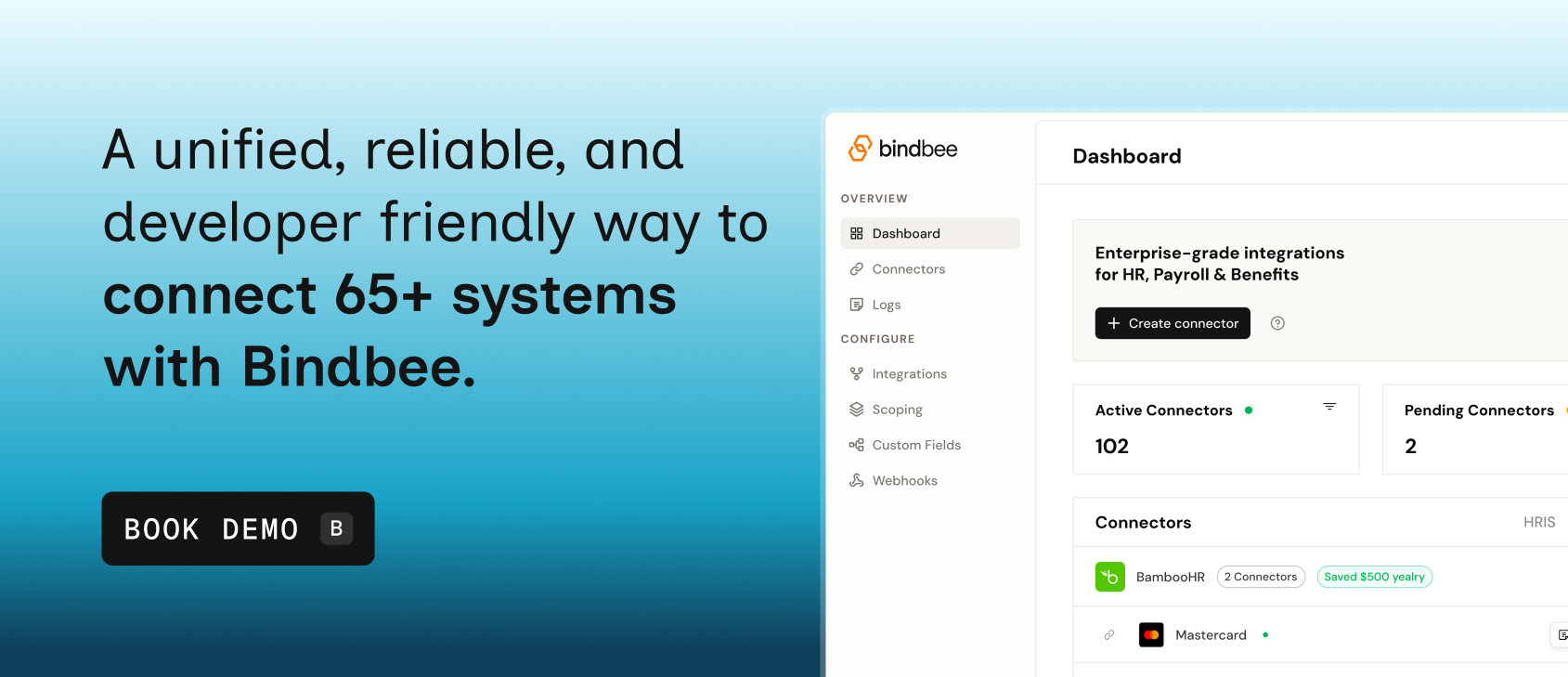
Book a demo to see how Bindbee's integration architecture handles the patterns above across 67+ HRIS systems.