

What is an Integration Partnership? Key Insights Explained
Summarise the blog with AI
.avif)
Even well-built SaaS platforms hit roadblocks when trying to connect with external systems. Each integration looks simple on the surface but requires custom authentication, unique data mapping, and continuous maintenance as the target API evolves.
For HR Tech and benefits companies, this isn’t a one-time problem. Your entire go-to-market depends on connecting to the HRIS and payroll systems your customers use.
This guide covers what integration partnership actually means in practice for B2B SaaS companies, and how to approach it strategically.
Key Highlights:
- Integration partnerships are the formal relationships between your product and the HRIS, payroll, and ATS vendors your customers use. Getting approved for API access is often the first hurdle.
- The build-vs-buy decision for integrations isn’t just about upfront engineering cost — it’s about ongoing maintenance burden as vendor APIs change.
- Unified APIs like Bindbee represent a new model: one partnership that covers 65+ systems, where Bindbee maintains the vendor relationships and you maintain one integration.
- Companies that treat HRIS connectivity as infrastructure rather than individual projects scale integration coverage 10x faster.
What Integration Partnerships Actually Involve

An integration partnership with an HRIS or payroll vendor typically involves:
- Partner program registration: Most enterprise HRIS vendors (Workday, ADP, UKG) require formal partner approval before granting production API access. This process can take 4–12 weeks.
- Use case alignment: You need to clearly articulate what data you’ll access, how you’ll use it, and what security standards you comply with.
- Security review: SOC 2, HIPAA, and data handling audits are standard for enterprise HRIS vendors before API approval.
- Technical certification: Some vendors (Workday) require formal integration certification, adding additional time and resources.
- Ongoing relationship management: As vendor APIs change, you need to maintain communication with the vendor’s partner team to stay ahead of breaking changes.
For each new HRIS system you want to support, this process repeats. At 3–5 integrations, it’s manageable. At 15–20, it becomes a dedicated function.
The Partnership Compounding Problem
The real cost of integration partnerships isn’t the initial setup. It’s the compounding maintenance:
- Workday deprecates a SOAP endpoint. Your integration breaks for customers on Workday.
- ADP rotates their OAuth token structure. Your sync fails until you patch it.
- UKG releases a new API version. Your field mappings become incorrect.
- Gusto changes their deduction write endpoint. Your benefits deduction workflow stops working.
Every one of these events requires engineering time. Multiply by 15+ integrations and you have an ongoing maintenance operation that competes with product work for your engineering team’s attention.
A Different Model: One Integration Partnership That Covers Everything
Bindbee’s unified API represents a different approach to integration partnerships. Instead of maintaining separate vendor relationships for each HRIS and payroll system, you maintain one partnership with Bindbee, which covers 65+ systems.
How it works:
- Bindbee maintains vendor partnerships: Partner program memberships, technical certifications, ongoing API monitoring, and relationship management for each system in the network.
- You maintain one integration: Your engineering team integrates once to Bindbee’s normalized API. That integration covers Workday, ADP, UKG, Rippling, BambooHR, and 65+ others.
- Vendor API changes are absorbed by Bindbee: When a vendor changes their API, Bindbee updates their connector. Your integration doesn’t break.
What This Means for HR Tech Sales Cycles
Integration coverage directly affects deal velocity. Prospects evaluate whether your product supports their HRIS system during the sales cycle. Companies with narrow integration coverage lose deals to competitors that cover more systems.
The math:
- Building one new integration in-house: 4–8 weeks and $50K–$100K in engineering cost
- Connecting to Bindbee and covering 65+ systems at once: significantly faster and cheaper
- Lost deal due to missing integration: $ACV * renewal risk compounded
Integration coverage isn’t a backlog item. For HR Tech companies, it’s a revenue lever.
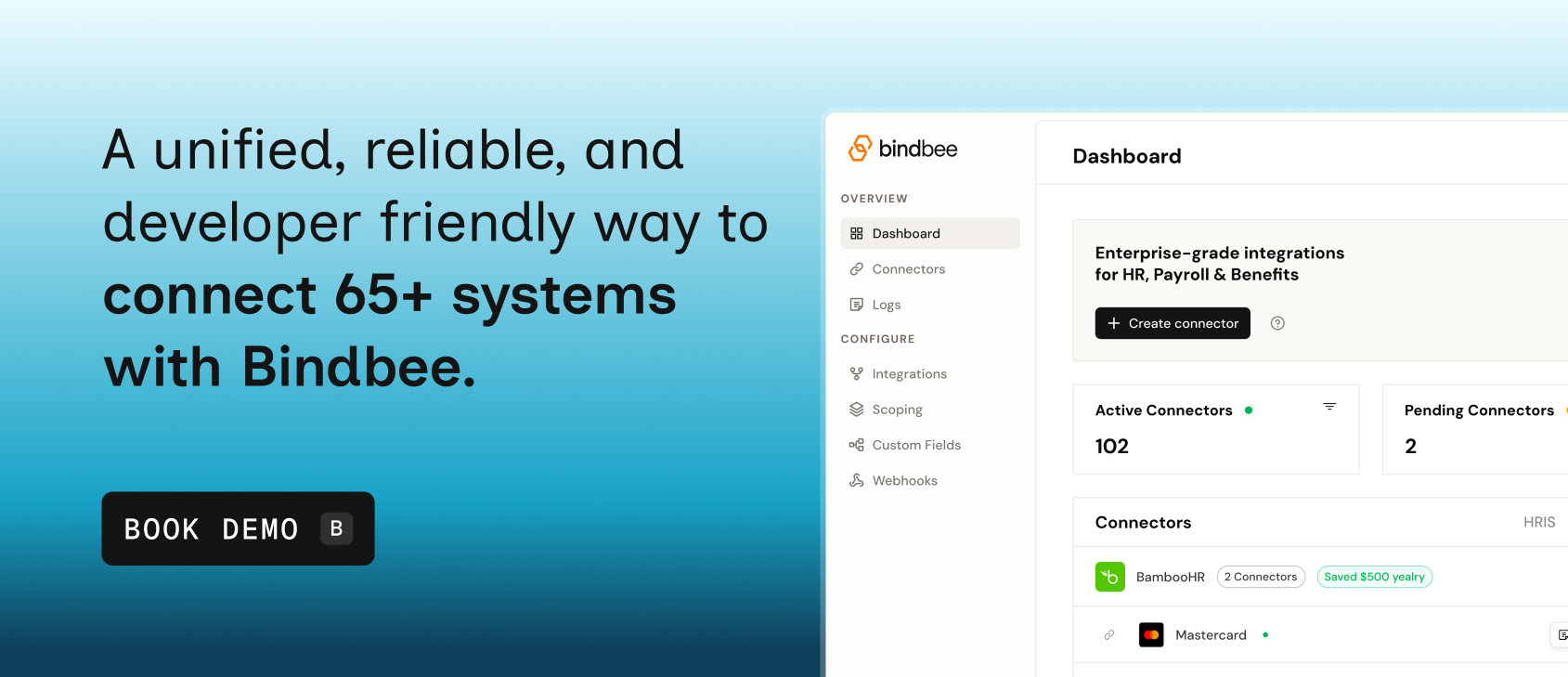
Book a demo to see how Bindbee’s integration partnership model covers 65+ HRIS and payroll systems through one connection.