

Integration Methods Comparison: API-First Approach 2025
Summarise the blog with AI

Integration methods have evolved significantly, and the API-first approach has emerged as the standard for modern software products. This guide covers the integration methods available, how to evaluate them, and why API-first design leads to more scalable, maintainable systems.
Integration Methods Overview
File-Based (SFTP/CSV)
Batch data exchange through structured files. Still common in benefits administration and legacy payroll. Introduces latency, data quality risks, and format maintenance overhead.
Database-Level
Direct database connections for data exchange. Fast but tightly coupled. Changes to schema or infrastructure on either side break the integration.
Webhook/Event-Driven
Real-time event notifications when data changes. Lower latency than batch approaches. Requires the source system to support webhook publishing.
REST API
Request-response data exchange over HTTP. The dominant modern standard. Flexible, well-supported, and increasingly the default for HRIS and payroll platforms.
Unified API
A single normalized interface covering multiple systems in a vertical. You integrate once and get access to dozens of platforms with consistent data models. This is the API-first approach taken to its logical conclusion for domain-specific integrations.
Why API-First Wins
API-first design means your product is built to integrate from day one. Every feature is accessible through a well-defined API, making it easier to connect with HRIS and payroll systems, easier to expose your product's data to downstream tools, and easier to maintain as both your product and external systems evolve.
For HR Tech platforms, API-first design combined with a unified API like Bindbee means you can connect to 65+ HRIS systems without building custom connectors for each.
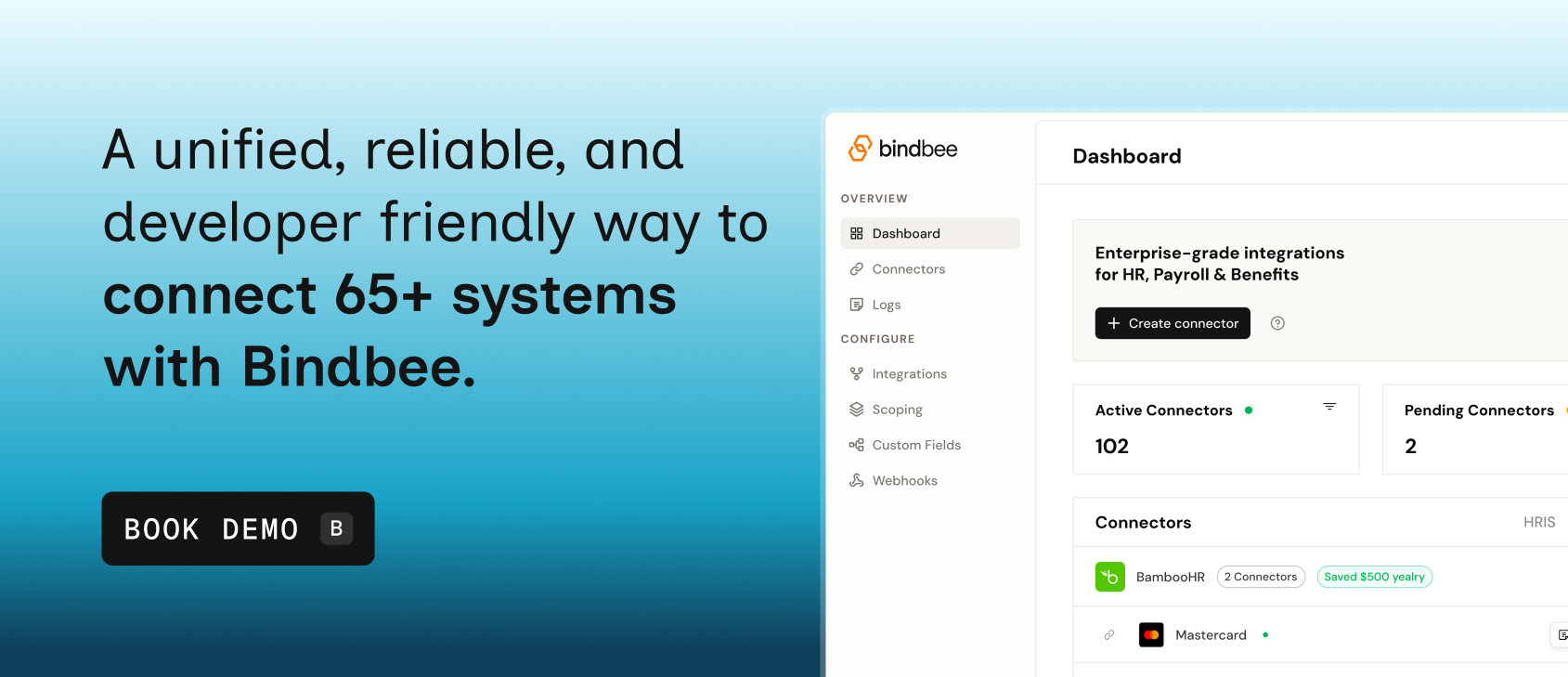
Book a demo to see how Bindbee's API-first approach accelerates HR Tech integration.