

6 Best Unified API Integration Strategies and Examples
Summarise the blog with AI
Your product roadmap is solid. Your integration layer isn’t. If your team is spending weeks per HRIS system, maintaining fragile custom connectors, and fielding support tickets every time a vendor changes their API, the problem isn’t your engineers. It’s the architecture. This guide covers integration strategies that actually scale for HR Tech and benefits platforms.
Key Highlights:
- The most common HR Tech integration failure isn’t a technical problem — it’s an architectural one. Building direct per-system integrations creates compounding maintenance debt.
- Unified API architecture reduces per-system complexity by normalizing all HRIS systems behind one interface, shifting maintenance responsibility to the API layer.
- The build-vs-buy decision for HRIS integrations changes significantly when you factor in ongoing maintenance cost, not just initial build time.
- Bindbee provides 65+ pre-built HRIS and payroll integrations with normalized data models purpose-built for HR Tech products.
The Core Integration Strategy Options

Option 1: Direct Per-System Integration
Building directly to each HRIS vendor’s API. Full control, high initial cost, high ongoing maintenance cost. Each vendor has different auth flows, data models, pagination patterns, and API versioning cadences. At 3–5 integrations, manageable. At 15+, a full-time maintenance operation.
Option 2: iPaaS / Workflow Automation
Platforms like Workato, MuleSoft, or Zapier connect systems through workflow automation. Strong for internal IT use cases. Weak for multi-tenant B2B SaaS products where each customer has their own HRIS connection. Pricing designed for enterprise IT budgets, not per-customer SaaS economics.
Option 3: Unified API
A normalized API layer that sits between your product and the HRIS systems your customers use. You integrate once; the unified API handles per-system complexity. Maintenance for vendor API changes falls to the unified API provider, not your engineering team.
For HR Tech and benefits platforms, unified API is the architecture that scales — it matches the multi-tenant, multi-HRIS reality of the market.
The Maintenance Cost That Changes the Math
Most build-vs-buy analysis focuses on initial build time: 4–8 weeks per integration for a senior engineer. That’s accurate but incomplete. The real cost is ongoing:
- Workday SOAP endpoint deprecation: engineering sprint to update
- ADP OAuth token structure change: sync failures until patched
- UKG API version upgrade: field mappings incorrect until fixed
- Gusto deduction write endpoint change: benefits workflow broken
Multiply by 15+ integrations and you have a continuous maintenance burden that competes with product work for engineering attention. Companies that build in-house at 5 integrations discover the maintenance problem at 15.
Bindbee for Unified HR Tech Integration
Bindbee’s unified API covers 65+ HRIS, payroll, ATS, and benefits systems with data models built for HR Tech and benefits workflows — not generic schemas.
- Pre-built connectors: Workday, ADP, UKG, Rippling, BambooHR, Gusto, Paychex, Paylocity, and more
- Normalized objects: employees, compensation, dependents, benefits enrollment, deductions, payroll runs, pay groups
- Write-back support: push deductions, enrollment updates, and contributions back to payroll with pre-negotiated write access
- SFTP adapters: file-based HRIS exports normalized through the same API endpoints as REST connectors
- Multi-tenant auth: Bindbee manages per-customer OAuth tokens and connection health
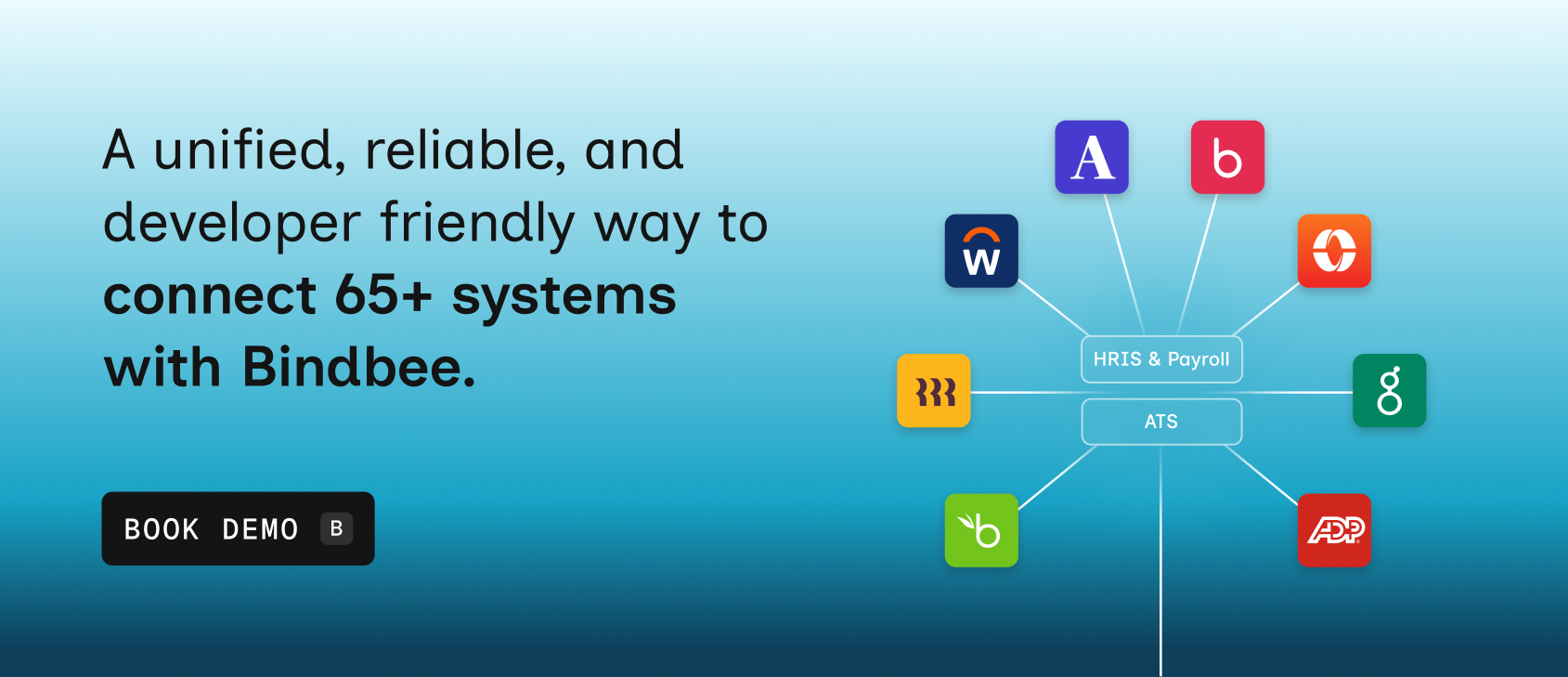
Book a demo to see how Bindbee’s unified API covers 65+ HRIS and payroll integrations for HR Tech products.